SAZANOS OTSKHANURI
SAZANOS OTSKHANURI
NUMBER OF REGISTRATION: 990
DATE OF REGISTRATION: 30/09/2025
AO: Sazanos Otskhanuri
NAME OF GOOD FOR WHICH REGISTRATION IS REQUIRED: Wine
NAME OF APPLICANT AND ADDRESS: LTD "Imeretian Wine Association"
Mukhiani 4th m/r, bld. 14, ap. 43, Tbilisi, Georgia
1. Name: "Sazanos Otskhanuri"
2. Type, Color, and Main Requirements
"Sazanos Otskhanuri" is red dry wine, that shall to satisfy the following requirements:
- Color – dark red;
- Aroma and taste – full-bodied, velvety, with berry (blackberry and blackcurrant) notes. Upon aging the pronounced bouquet develops with notes of spices (pepper, cloves) and with notes of dried fruit (black plum).
- Actual volumetric spirit content - no less than 11 %;
- Maximum spirit sontent - no more than 15%;
- Sugar content - no more than 4 g/l;
- Titrated acidity - no less than 4 g/l;
- Volatile acidity converted to acetic acid - no more than 2 g/l;
- Total mass concentration of sulfur dioxide - no more than 150 mg/l;
- Sugar-free extract mass concentration - no less than 22 g/l.
3. Geographical Area and Zones of Production
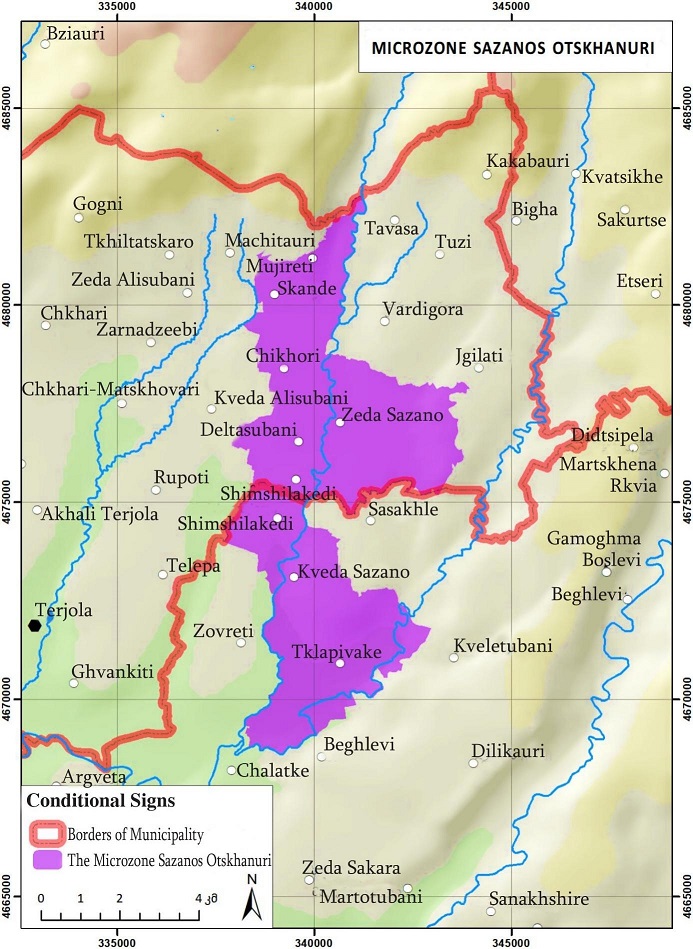
Sazano microzone includes the villages of Terjola municipality:
Zeda Sazano, Skande, Mujireti, Chikhori, Deltas Ubani, Shimshilakedi, and
The villages of Zestaponi municipality:
Kveda Sazano, Tklapivake and Shimshilakedi.
The microzone is located on 120-420 m above sea level.
4. Vine Varieties
The wine "Sazanos Otskhanuri" shall be produced only from Otskhauri Sapere vine variety grapes harvested from Sazano microzone, and use of other varieties is prohibited, however addition of 5% Saperavi from the same microzone is permitted.
5. Vineyard Cultivation, Pruning, Shaping and Maintenance
- Sazano microzone vineyards intended for "Sazanos Otskhanuri" production shall be cultivated at an altitude of 120-420 m above sea level;
- The distance between rows in a vineyard – 1-3 m;
- The distance between vines in the row – 0,8-1.5 m;
- Height of stamp – 60-90 cm;
- Shape of pruning – one-sided, two-sided or free.
6. Grape Ripening, Vintage, Transportation
- "Sazanos Otskhanuri" is produced only from ripe grapes. Sugar content at the vintage shall be no less than 20 %;
- Grape transportation is allowed only in wooden or plastic boxes, bags, stainless steel, plastic or painted with special dye bodies;
- Grape transportation with polyethylene packages and/or bags is prohibited;
- The grapes shall be maximally protected from possible contamination.
7. Grape Harvest and Wine Amount
Grape harvest in 1 ha vineyard shall not exceed 8 tons for Otskhanuri Sapere.
Wine amount shall not exceed:
- 650 l – from 1 ton grapes;
- 5200 l – from 1 ha Otskhanuri Sapere vineyard.
8. Grape Processing, Winemaking and Bottling
The grapes intended for "Sazanos Otskhanuri" production shall be picked only from vineyards of Sazano microzine.
Grape processing, winemaking and bottling is permitted only within the borders of Sazano microzone.
"Sazanos Otskhanuri" is made by whole alcoholic fermentation of must in a qvevri (wine jar) or stainless steel reservoir.
"Sazanos Otskhanuri" marketing is permitted exceptionally in bottles.
Only the operations, materials and substances permitted by Georgian Legislation ("The Technical Regulation On General Rules of Winemaking and Determination of the List of Processes, Material and Substances" approved by the Resolution №524 of the Government of Georgia of November 6, 2018) are permitted to be applied for the production of "Sazanos Otskhanuri".
9. Link between Wine Exclusive Quality and Geographical Area
Climate – is moderately humid, with hot summer and mild winter, annual duration of sunlight exceeds 1.800 hours, and reaches 1.298 hours during vegetation period.
Average annual air temperature is 15.4◦C.
The sum of active temperatures is 4353.9◦C.
Annual total precipitation is 1360.2 mm, of which 698.8 mm falls during vegetation period.
Average annual relative humidity is 71.1%, while the same indicator for vegetation period
is 72%.
Soils. The microzone is located in the Eastern part of Imereti lowland, and includes the valleis of Dzusi, Smordoli, Chkhari, Buja and Cholaburi rivers. The most of territory is characterized with flat relief. The soils of microzone are mainly alluvial carbonated. In the Northern part of microzone the yellow soils are found, as well. The soil is loamy and heavy loamy in mechanical composition. In one section, it is characterized with rough texture. The soils are characterized with deep profile, profile thickness varies within 1–1.5 m, and active humus layer is 50–70 cm.
According to morphological characteristics, the alluvial soils are brownish-grey in upper layers, and becoming grey downwards; the structure is coarse-grained and stony. In deeper layers, it is weakly expressed.
Soil reaction is neutral to slightly alkaline – pH is in the range of 5.8-7.6.
Human Factor – Viticulture and winemaking have existed in Imereti since time immemorial, and have always been the main branch of the agricultural activity of the local population.
Despite a number of obstacles the development of viticulture in Imereti had relatively broad prospects from the second half of the 19th century. In 1873, the area of vineyards in Imereti amounted to 19.377 ha, and was steadily increasing. Whole area in 1875 increased to 21.370 ha, and from 1895 – 23.585 ha.
Georgian ampelography states: Otskhanuri Sapere is fairly common Imeretian vine variety, and according to comprehensive vineyard census of 1940, Otskhanuri Sapere occupied a total area of 91 ha, and according to the 1953 census – 112 ha throughout Imereti region.
It should be noted that Imereti is considered as one of the most important winemaking regions. It ranks first in Western Georgia in terms of richness of vine varieties, and area of vineyards. Viticulture is leading agricultural sector in many districts of Imereti.
Imereti wines made from grapes of mountain slopes and inclinations are distinguished with high quality. These wines are generally of moderate strength, characterized with tenderness, subtlety, and distinctive aroma when young, and well-developed bouquet – when aged. Samples of Imereti wine presented by W. Thiebaud at the 1887 World's Fair in Paris, were judged as the best table wine, and awarded with gold medal. These wines were also appreciated and awarded in 1889-1890 in Paris, Bordeaux, Edinburgh, Tbilisi and other cities (V. Thiebaud).[1]
Otskhanuri Sapere is particularly distinguished among Imeretian red vine varieties, it originally belongs to Colchis varieties, and with its morphological and economic characteristics, it is included in ecological-geographical group of prol pontic, sub prol. georgica Negr. According to some signs, it is transitional between cultural and wild varieties. Its thickly and deeply lobed lanceolate leaves, small flowers, and highly variable ratio of stamen length to bud height (1 to 2), and small, dense clusters, small, round, unevenly sized berries and fine-grainedness (presence of green, immature berries in ripe black berries) characteristic of variety confirms great age of breed, and its recent introduction into culture from the wild. It is also noteworthy that Otskhanuri Sapere does not normally grow as low-height vineyard; in such conditions, it yields small harvest, therefore, it is grown in more suitable semi-tall form, the so-called olive grove method, during which the variety develops well, and yields bountiful harvest. According to comparative assessment of morphological and economic characteristics, Otskhanuri Sapere appears to be the oldest vine variety. Because of this we think that it has not been introduced into cultural conditions very long ago, and the influence of centuries-old culture (care and maintenance) on the breed is not clearly visible, and it has not changed or improved much compared to its original state. Sugar content and acidity of Otskhanuri Sapere during the harvest in 1939-1950 were tested in Sazano, and it was confirmed that its sugar content ranges from 19.6 to 23.3%, and its acidity is between 7.7-10.4. From these reports it is clear that Otskhanuri Sapere accumulates sufficient sugar for table wine, but it provides the best sugar-acidity ratio in Imereti.[2] Observations conducted in the 1950s showed that under optimal conditions Otskhanuri Sapere can accumulate sugar content up to 23-24%.3 Currently, this variety for industrial purpose is widespread only in Imereti region. In recent years, high-quality Otskhanuri sapere has been cultivated in this region, The importance thereas entrepreneurial vine variety was determined as a result of increase in vertical zonality thereof related to global warming making possible to cultivate grapes with high sugar and acidity throughout Imereti, and based on this the production of wine with special qualities. The demand for this wine is growing in the domestic and foreign markets, as well.
Otskhanuri Sapere belongs to standard late-ripening vine varieties. It stands out among Imeretian red grapes: with its high wine quality, intense color, fullness, tenderness, harmonious taste, and freshness. Even 80 years ago, Prof. K. Modebadze noted considerable vitality of ancient wines of this brand, and indicated an improvement of wine taste characteristics during the maturation, and as high-quality variety it has good prospects for middle and upper Imereti districts.[3]
Otskhanuri Sapere is common vine variety in Zestaponi and Terjola districts.4 In other districts of Imereti, it occupies negligible area. According to 1940 general census of vineyards, Otskhanuri Sapere occupied total area of 94 ha, and according to 1953 census, it occupied - 112 ha.
This area is unevenly distributed among individual regions. Relatively small distribution of the variety is due to its late maturity and low yield during lowland formation.
Classic viticulture zone includes the valleys of Dzirula, Kvirila, and Rioni rivers.
One of industrial vine varieties widespread in Imereti is Otskhanuri Sapere, wherefrom the highest quality red wine is made.5
The book "Chinchkhlebi Chikashi" (Rages in Glass) by Giorgi Abashidze, published on the occasion of 75th anniversary of Lower Sazano Winery, talks about "Otskhanuri Sapere". Among vine varieties preserved in Imereti, Otskhanuri Sapere is widespread in the village Kveda Sazano and is very late-ripening table wine variety.6
For centuries, in Imereti (and almost all of Western Georgia), there was a tradition of coloring white wine red, and Otskhanuri Sapere was considered the best way to color white wine red.
10. Transitional Provisions
Notwithstanding the requirements of Paragraph 9 of this production specification, the grape processing and winemaking are permitted outside Sazano microzone, within the territory of Georgia, until December 2026.
11. Special Labeling Rules
The name "Sazano Otskhanuri" and the indication "Protected Designation of Origin Wine" shall be placed on the label, package, and in the documents accompanying the wine and in advertising materials, as well, in various languages as follows:
12. Recording and Reporting
Recording and reporting of production technological processes are provided in accordance with the "Rules for Recording and Reporting Technological Processes in Viticulture and Winemaking Practice" approved with the Order No. 2-78 of the Minister of Environmental Protection and Agriculture of Georgia of January 24, 2019.
13. Main Control Points
During the state control of production process of Protected Designation of Origin Wine "Sazanos Otskhanuri" the producer shall confirm the compliance of following parameters at the internal control of the LEPL National Wine Agency and "Imeretian Wine Association":
| Main Control Points | Methods of Packing |
| Vineyards location | Cadastre map, control on the place |
| Area | Vineyard recording journal, cadaster |
| Vine variety | Vineyard recording journal, control on the place |
| Cultivation methods | Journal for registration of agrothechnical activities, treating journal. Control on the place |
| Vintage and transportation | Vintage journal |
| Grape harvest on ha | Vintage journal |
| Grape whole harvest | Vintage journal |
| Grape processing and winemaking | Grape receipt journal, grape processing journal, product turnover journal, laboratory analysis journals, notifications, on-site inspection |
| Place and conditions for bottling, packing and storage of wine | Bottling journal, product storage and movement journal, laboratory analysis journals |
| Physico-chemical characteristics of wine during the winemaking process, before and after bottling | Laboratory analysis journals |
| Wine organoleptic characteristics | Tasting Commission proceedings |
| Traciability | Technological and laboratory records |
14. Production Control Body
State control over the production of Protected Designation of Origin Wine "Sazanos Otskhanuri" is provided by the LEPL National Wine Agency, in accordance with the Order No. 2-1008 of the Minister of Environmental Protection and Agriculture of Georgia of 2018, and internal control is provided directly by the Imeretian Wine Association at all stages of production, per year.
[1] Ampelography of Georgia, Publishing House of the Academy of Sciences of the Georgian SSR, Tbilisi,
1960, p. 33
[2] Internet Site – https://enoteca.ge/ge/variety/81-Otskhanuri-Safere
[3] 24 Hours, March 15, 2013, Otskhanuri Sapere, who fell from the "skyscraper", Levan Sepiskveradze.
4 Tamaz Kobaidze, "Directory of Georgian Grape Varieties", Tbilisi, 2014, p. 85
5 Maia Mirvelashvili, Davit Maghradze, "Vine and Wine Culture in Georgia", Tbilisi, 2015, p. 72
6 Giorgi Abashidze, "Rages in Glass", Kveda Sazano Winery 75, Kutaisi 2005.